BS4142:1999 - The likelihood of complaint from noise in mixed residential and industrial areas
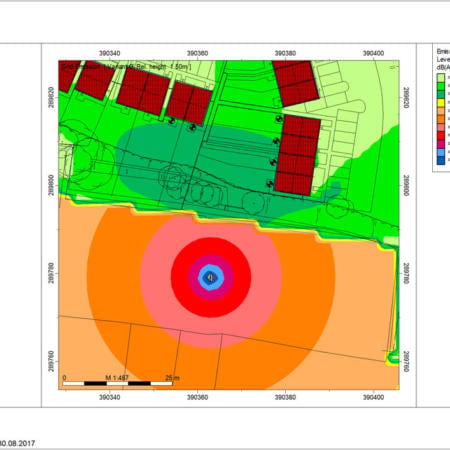
The most relevant criteria to assess the impact of a new noise source located, or proposed to be located, close to residential developments is contained within BS4142:1997 – Rating industrial noise affecting mixed residential and industrial areas. This British Standard describes a method of determining the level of a noise of an industrial nature, together with procedures for assessing whether the noise in question is likely to give rise to complaints from persons living in the vicinity.
The likelihood of complaint in response to a noise depends on factors including the margin by which it exceeds the background noise level, its absolute level, time of day, change in the noise environment, as well as local attitudes to the premises and the nature of the neighbourhood. BS4142:1997 is only concerned with the rating of a noise of an industrial nature, based on the margin by which it exceeds a background noise level with an appropriate allowance for the acoustic features present in the noise. As this margin increases, so does the likelihood of complaint.
Certain acoustic features can increase the likelihood of complaint over that expected from a simple comparison between the specific noise level and the background noise level. Where present as part of the assessment, such features are taken into account by adding 5 dB to the specific noise level to obtain the rating level:
+ the noise contains a distinguishable, discrete, continuous note (whine, hiss, screech, hum, etc.);
+ the noise contains distinct impulses (bangs, clicks, clatters, or thumps);
+ the noise is irregular enough to attract attention.
The rating level is equal to the specific noise level if there are no such features present or expected to be present. To assess the likelihood of complaints using BS4142:1997 the measured background noise level is subtracted from the rating level. The greater this difference the greater the likelihood of complaints, such as:
• A difference of around +10 dB or more indicates that complaints are likely.
• A difference of around + 5 dB is of marginal significance.
•If the rating level is more than 10 dB below the measured background noise level then this is a positive indication that complaints are unlikely
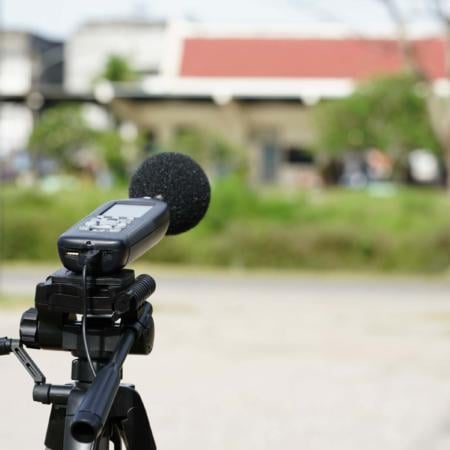
A noise survey requires that the following measurements are taken over a period relevant to the operational times of the industrial scheme:
• LA90, 1hour for daytime operation.
• LA90, 5min night time.
• Specific LAeq noise measurement or calculation.
The equipment and problems which can require a survey to BS4142:1997 include:
• BS4142 Air conditioning unit noise survey
• BS4142 Air condenser noise survey
• BS4142 Generator noise survey
• BS4142 Fan noise survey
• BS4142 Duct noise survey
• BS4142 Flue noise survey
• BS4142 Kitchen extraction noise survey
• BS4142 Chiller noise survey
• BS4142 Water pump noise survey
• BS4142 Mechanical lift noise survey
“The likelihood that an individual will complain depends on individual attitudes and perceptions in addition to the noise levels and acoustic features present. This standard makes no recommendations in respect of the extent to which individual attitudes and perceptions should be taken into account in any particular case.”
Where there is a relationship between the number of complaints to noise and the level of community annoyance, quantitative assessment of annoyance is beyond the scope of this standard. The World Health Organisation – Guidelines for community noise should generally be consulted in support of a BS4142:1997 assessment to evaluate nuisance and annoyance.
Similarly where a low frequency problem exists, it is beyond the standard to make a valid assessment. The use of single figure A-weighted measurements in BS4142:1997 does not take account of complete octave band sound spectrum a noise contains.
“Regulatory authorities must accept that annoyance by low frequency noise presents a real problem which is not addressed by the commonly used assessment methods. In particular, the A-weighted level is very inadequate, as are the NR and NC criterion curves.”
Leventhall HG. Low frequency noise and annoyance. Noise Health 2004;6:59-72
Additional guidance from the WHO or Department of the Environment, Food and Rural Affairs (DEFRA) is consulted where the scope of the standard is specified beyond its original intention. This can include the following areas:
• Nightclub Noise
• Open-air concert noise
• Public house noise
• Fast food restaurant noise
• Workshop noise
• Garage repair noise
• Car Wash Noise
During the application process a BS4142:1997 survey may be requested The Planning Authority or Environmental Health Department if there is a risk of increased noise levels. Sound Solution Consultants can evaluate the problem and then carry out the necessary survey in accordance with BS4142:1997 and other relevant guidance that may be required. We can provide you with the necessary report and recommend a noise mitigation strategy to satisfy the local authority.
For more information on the different types on surveys carried out by Sound Solution Consultants, please visit our Noise Survey page.